|
telescopeѲptics.net
▪
▪
▪
▪
▪▪▪▪
▪
▪
▪
▪
▪
▪
▪
▪
▪ CONTENTS ◄ 7. OBSTRUCTION EFFECTS ▐ 7.1.2. Telescope central obstruction: size criteria ► 7.1.1. CENTRAL OBSTRUCTION EFFECT: THEORETICAL INCONSISTENCY?
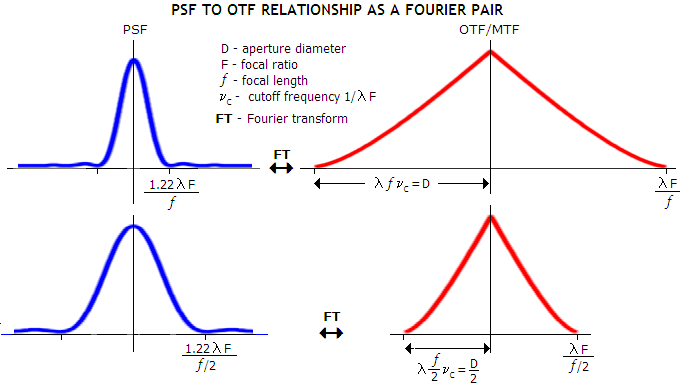
While this formalism should accurately describe contrast transfer between zero and cutoff frequency for annular aperture, it is not appropriate for determining the cutoff frequency. The reason is that annular pupil produces diffraction pattern reduced in size with respect to that of clear aperture of the same diameter - in effect, a pattern nearly identical to one produced by a larger clear aperture with spherical aberration, in which the level of aberration does not cause change in cutoff frequency. In other words, it is physically impossible that a near-identical impulse response (PSF) produces two significantly different MTF cutoff frequencies. This conclusion is consistent with the relation between PSF and OTF, which are for incoherent light Fourier pair, implying that any given PSF will produce a single corresponding OTF. Since the annular aperture PSF is narrower than that of a clear aperture of the same diameter, its OTF will be wider, i.e. will expand toward higher frequencies. Plots below illustrate the Fourier transform relationship between angular size of the PSF (first minima 1.22λ/D radians) and the extent of OTF frequency spectrum (linear cutoff period λF and frequency 1/λF, angular cutoff period λ/D period and angular cutoff frequency D/λ) for perfect circular pupil of diameter D (top) and for half as large perfect aperture (bottom) of identical focal ratio.
This is strictly valid for perfect
unobstructed aperture, but as far as the cutoff frequency is concerned, it
extends to apertures with significant level of aberrations
(~0.5-1 wave P-V, depending on aberration type), as well as those
with central obstruction in the usual range (up to ~D/2). Any change
in the PSF shape changes the shape of OTF/MTF, which in this case
represents a pulse, whose shape is determined by
frequency spectrum represented by the PSF.
OTF is directly determined by the PSF and, while it uses a line pairs continuum, its
cutoff frequency for aberration-free aperture is practically identical to that for a
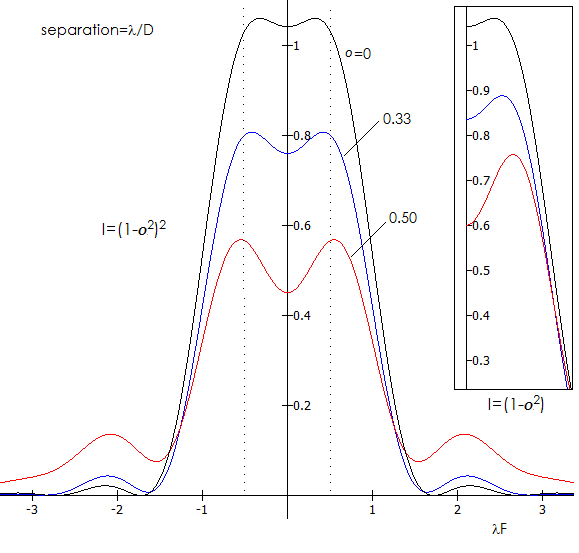
point source. Graph below shows what a pair of identical PSF functions, normalized to
unit peak intensity, look like placed
at λ/F separation, for clear, 0.33D and 0.50D obstructed aperture.
Box at right shows those same plots for the more appropriate relative
intensity distribution w/o vignetting effect (i.e. central intensity
given by 1-o2).
At λ/D separation, perfect clear aperture has intensity deep
between the two peaks of ~1.7%, for less than 0.9% contrast
(from the general contrast relation, C=[Imax-Imin]/
[Imax+Imin], where the maximum intensity
Imax is normalized to 1).
At the same point separation, obstructed aperture not only
has a deeper contrast drop in between
two maximas, but also more widely separated peaks, the larger
obstruction, the more so. It is obvious that the presence of
obstruction should result in a higher cutoff frequency, and it is not
necessarily in disaccord with a general statement that the cutoff
frequency of an obstructed aperture equals λ/D. That same
rule applies to apertures of all sizes, but they have different angular
cutoffs, inversely proportional to the aperture diameter. It is
evident that the presence of central obstruction, while not affecting
focal length, hence neither the formal focal ratio,
does shrink the physical diffraction pattern, without changing
F-ratio, i.e. image scale. In other words,
it makes diffraction pattern smaller angularly.
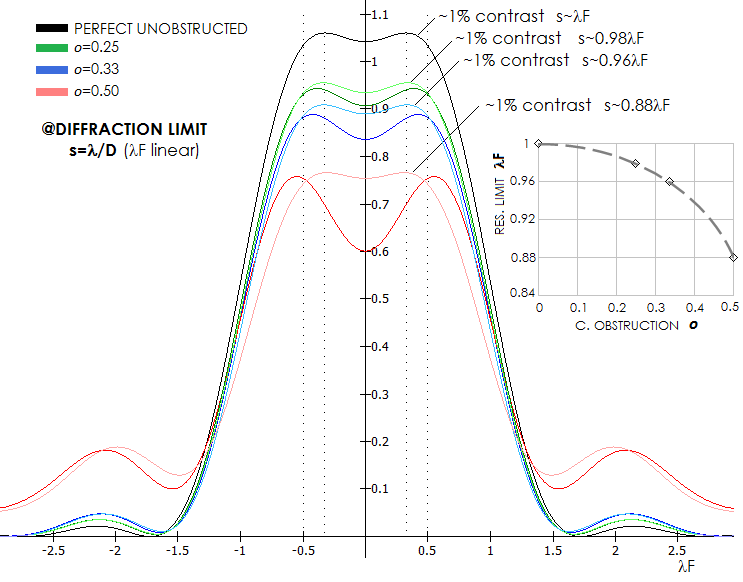
Taking a closer look shows that the ~1% contrast level of a perfect
clear aperture at the point separation ~λ/D (i.e. λF
linearly)
corresponds to wider point separations for obstructed apertures
than indicated by their actual central maxima width. For instance,
at o=0.5 the central maxima radius is 19% smaller,
but the 1% contrast falls not at 0.81λF, but
at 0.88λF separation. By interpolating curve
into the 1% contrast separation for the three obstruction sizes, an
approximate rate of resolution limit with the increase in central
obstruction can be obtained (right). Fair approximation of the
resolution limit of an aperture D with the relative central
obstruction "o" is given by (λ/D)
(1-o3). Note that the 0.88 is rounded off; the
exact 2% deep in the intensity, i.e. 1% contrast falls midway
between 0.88 and 0.89. However, the 1.7% intensity deep, i.e.
less than 0.9% contrast - equal to that
of a perfect unobstructed aperture at λF separation -
occurs at 0.88λF separation. Near threshold, it changes
very quickly: at 0.9λF separation, intensity
deep is already 4%, for 2% contrast, more than double that at the
resolution limit.
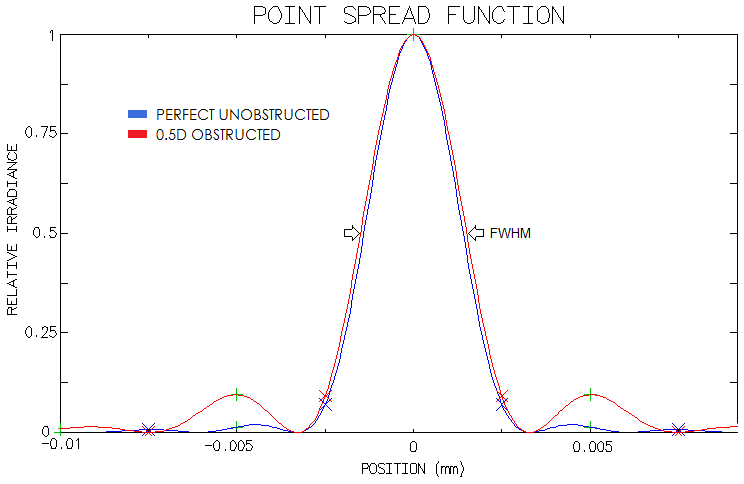
The cause of the discrepancy between the smaller central maxima of
obstructed aperture and its resolution limit is that for any given
first minima radius, the FWHM (width at half-intensity) of
obstructed aperture is wider, hence at any given radius value
the sum of the two intensities is higher (below; for comparison
purposes, both PSFs are normalized to 1). In other words, its
central intensity profile is different than that of clear perfect aperture, resulting in a different corresponding OTF.
Follows an example of the obstructed aperture PSF and
its properties, illustrating this conclusion, i.e. higher MTF
cutoff frequency of annular aberration-free aperture
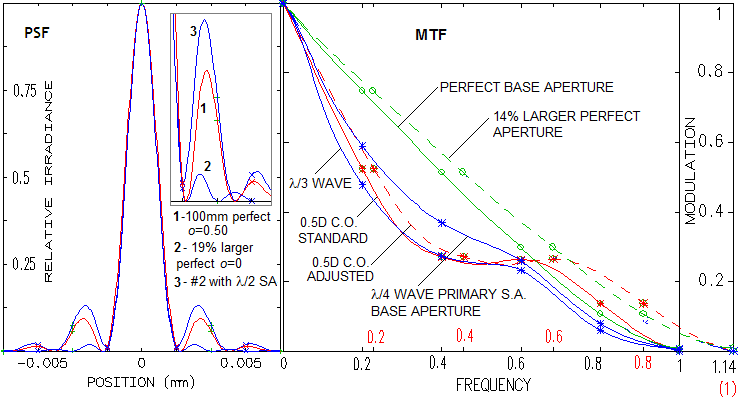
vs. circular aperture of the same diameter. Raytrace was done with
D=152mm f/5 mirror. At left, the base
(obstructed) aperture diameter is 152mm, and the clear aberrated is 11%
larger, corresponding to ~10% Airy disc diameter reduction with
o=0.32. The latter has *lambda;/4 wave P-V of primary spherical
aberration At right, the standard and proposed actual MTF plot for
o=0.5 obstructed aperture.
LEFT:
PSF
of a clear aberration-free aperture of diameter D with 0.50D
central obstruction (red) nearly coincides with the PSF of 19% larger
(linearly, 1.19D diameter) clear aperture (blue, both for perfect and
aberrated beaperture, as shown magnified in the box top right).
For comparison purposes, all PSFs are normalized to 1.
Central maxima of the obstructed aperture - reduced by about 19% in
diameter due to the effect of central obstruction -
is nearly identical to that of a larger aberrated clear aperture
in monochromatic light (the latter is still slightly smaller, due to
spherical aberration making the PSF maxima of the
aberrated aperture slightly smaller than with the perfect aperture
PSF). The two Airy discs radii are nearly identical, yet, according
to the standard MTF
formalism, the smaller obstructed aperture will have 19% lower cutoff frequency, given as
D/λ (cycles per radian; related
to the linear resolution as D/λf=1/λF
lines per mm, f
being the focal length and F the focal ratio),
i.e. as much worse limiting MTF resolution. Evidently, there is no
basis for such a difference in their respective PSFs.
RIGHT:
the plots at right indicate that the actual effect of central obstruction on
contrast over the range of MTF
frequencies is significantly smaller than what the standard formalism implies.
The effect of λ/4 wave P-V of primary spherical is (very) roughly
comparable to that of o=0.5, not o=0.33 c. obstruction.
Of course, two systems with different cutoff frequencies are not fully
comparable; comparison is only possible over the range common to both of
them, with the excess of resolution beyond that range being a
qualitative advantage of the corresponding aperture in that respect. If
this looks unrealistic, dwarfing the effect of central obstruction, think of
all other factors involved. The typical instruments in comparison are
a smaller refractor and larger reflector or catadioptric. For example,
common belief is that a 6-inch reflector/catadioptric with ~D/3
c.obstruction compares to a 4-inch
refractor (apo or long focus) with respect to planetary performance, and
that it is central obstruction that causes it. But larger aperture has also
larger seeing error, proportional to
(Dl/Ds)5/6. In this example, if the 4-inch
aperture averages 0.075 wave RMS seeing error (comparable to λ/4 wave
P-V of defocus), the 6-inch will average 0.105 wave (more than λ/3
wave). And the refractor typically also has smaller errors from
miscollimation, thermal imbalances and surface imperfections. ◄ 7. OBSTRUCTION EFFECTS ▐ 7.1.2. Telescope central obstruction: size criteria ►
|