|
telescopeѲptics.net
▪
▪
▪
▪
▪▪▪▪
▪
▪
▪
▪
▪
▪
▪
▪
▪ CONTENTS
◄
13.5. Higher-order eye
aberrations
▐
13.7. Combined eye
aberrations, diffraction
► 13.6. EYE CHROMATISM
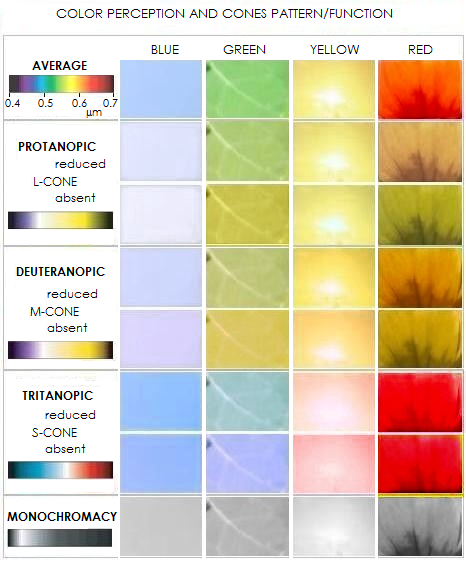
PAGE HIGHLIGHTS Human eye generates significant chromatic aberration, in the form of primary spectrum and lateral chromatism. The latter, like other typical off-axis aberrations, is commonly present in the eye on axis as well. While most of the false color is filtered out during neural processing, negative effect of the energy spread caused by chromatic aberrations on image contrast remains. Most of the filtering is due to the low effective magnification at which the eye operates. At the average 3-4mm pupil diameter, Airy disc diameter of the image of a point source on the retina averages nearly 7 microns, i.e. spans the length of little over three foveal cones. For comparison, Airy disc formed on retina by 80mm f/5 refractor with 20mm eyepiece (20X magnification) is only about 15% smaller (by the ratio of eye focal length vs. that of the eyepiece). Despite very significant chromatism of the refractor, it is not apparent, except on brightest objects. Perception of chromatic error is also somewhat attenuated by the retinal cone distribution. S-cones, whose pigment absorbs short wavelengths, are nearly absent over about 1° of the central fovea (foveola). The result is altered color vision, with the rainbow of colors created by eye nearly reduced to red, white and blue (tritanopic vision, FIG. 232). In addition, anomalies in the average threechromatic cone response - dichromatic phenotypes with one of the three cone responses reduced or absent (protanopic, deuteranopic and tritanopic vision, the last being anomalous when present outside of foveola) - are not uncommon. In general, these anomalies decrease color discrimination, and with it the perception of chromatic error.
FIGURE 232: Color perception varies significantly not only with the relative distribution and arrangement pattern of S, M and L cones over the retina, but also on their proper function and the manner in which neural pathways process their input. In general, imbalance between the number of L cones vs. M cones alone may not necessarily have significant effect on color vision; it is possible that the two cone types have different photon absorbing efficiency, offsetting the imbalance, or that it is done during neural processing. In a simplified scenario, shown at left, changes in color perception are simulated only based on the number of (assumed properly functioning) cones, also assuming uniform neural processing. Relatively common color perception anomaly is L-cone related protanopic vision, affecting up to about 2% of males, and less than 0.1% of females (about a half with L-cone response entirely absent). Blue, green and red are suppressed, reducing color reinbow over the visual spectrum to mainly yellowish hues (bottom strip). M-cone related deuteranopic vision is similar in effect (somewhat warmer yellowish hue), but more common, about 5% in males and less than 0.1% in females, with the near-extreme form of anomaly (no M-cone reponse) of about 1%. The reduced S-cone response- tritanopic vision - is nearly equally rare in males and females, about 0.1%. However, S-cones are normally absent over nearly entire foveola, which makes it tritanopic in its color perception. Monochromacy is very rare; it can be BCM (blue cone monochromacy, ~0.001% incidence), with S-cone response alone, or total monochromacy (~0.003%), with no cone response whatsoever. Unlike monochromatic aberration, the range of individual variations in eye chromatism is narrow. It is the consequence of chromatism being affected mainly by dispersive properties and power of optical elements, while relatively insensitive to their surface deviations and misalignment. Eye generates both, longitudinal and lateral chromatism, with the latter commonly present on axis as well, although usually insignificant. Being a system of positive optical power, with a narrow range of deviation in the refractive index and dispersion, eye generates form of longitudinal chromatism called primary spectrum: shorter wavelengths focus closer than the longer ones. Studies agree that longitudinal the chromatic defocus over the entire visible spectrum - as a differential between respective foci of 400nm and 700nm wavelength - is about 2D (diopters). Regular off-axis lateral chromatism is a function of incident angle, but also dependant on the position of aperture stop. Axial lateral chromatism results from prismatic deformation and/or tilt element in actual eyes (FIG. 233).
In units of eye's focal length in diopters - about 59 (for the effective focal length fE~17mm) - 2 diopters of defocus between 0.4μ and 0.7μ wavelengths is slightly over 1/30, or about 0.56mm. With respect to the wavelength of maximum photopic eye sensitivity, 0.55μ, this translates into 11 waves P-V of defocus at 5mm eye pupil diameter, and 1.8 waves at 2mm. For the standard C and F Fraunhofer lines, defocus is nearly 0.9 diopters, or 0.25mm; with respect to the e-line focus, according to the graph, it nearly splits in two, being only slightly larger for the red C-line. In terms of the standard measure of chromatism, this primary spectrum has longitudinal error of 0.12mm/17mm=0.07, or f/140. This is about 14 times more than secondary spectrum in an achromat. Still, at 2mm pupil diameter it causes only about 0.4 wave P-V defocus in either bleu F- or red C-line. That is comparable to the chromatism of a 100mm f/30 achromat. An interesting question is how does this eye chromatism affect telescopic image? How it combines with chromatism of refracting telescopes? FIG. 234 illustrates its effect on the formation of the retinal image with an achromat, but the chromatic shift of the objective's image plane focused onto retina is also taking place with other telescope types, including all-reflecting telescopes.
When observing through the eyepiece, what is focused onto the retina are images of point sources filling the eyepiece's field stop. The totality of these point source images forms the retinal image of the image formed by the objective in the eyepiece's field stop. The point emitters in the field stop are of all the wavelengths transmitted by the objective. Their light enters the eye nearly collimated; how it focuses onto the retina depends primarily on the refraction within eye. Since primary spectrum of the eye, shown on FIG. 233A, can be approximated as L~4√λ-0.4 diopters, for the wavelength range 0.4μm<λ<0.7μm (thus with zero defocus at 0.4μm wavelength focus and maximum at 0.7μm), relative defocus for zero at λ~0.546μm is L'~4√λ-0.4-1.53 diopters. To bring wavelength to focus onto retina, its source needs to appear to the eye as coming from a distance greater than its focal length fE=17mm by a factor of 59/L', or OE~1000/L' in mm. Since this results from rays exiting the eyepiece being slightly diverging or converging, the object distance OE for the eye equals the image separation IEP for the eyepiece, with the corresponding shift of the imaged plane onto retina for wavelength λ from the eyepiece's field stop plane, from the Gaussian lens formula, given by D=fEP2/[fEP-(1000/L')], where fEP is the eyepiece focal length in mm. In other words, eye primary spectrum effectively shifts image plane of lower-sensitivity wavelengths projected onto retina from the eyepiece's field stop, with the magnitude of shift determined by: (1) the wavelength's primary spectrum L' relative to the zero defocus wavelength, and (2) eyepiece's focal length fEP. Taking e-line as zero defocus wavelength, as shown on FIG. 233A, the respective shifts for F and C-line are about 0.0094mm and -0.011mm with 5mm f.l. eyepiece, and -0.155mm and -0.178mm with 20mm f.l. eyepiece. With an eyepiece of ~36mm f.l., image plane focusing onto the retina for the blue F-line nearly coincides with the common C/F focus of a 100mm f/10 achromat. Thus, the F-line focus is brought onto the retina together with e-line focus; however, due to low magnification, and much higher eye sensitivity to the green, it is bellow the threshold of perception. In general, the effect of eye's primary spectrum is negligible compared to achromat's secondary spectrum. It is still small in apochromats and all-reflecting telescopes. With an eyepiece of, say, 5mm f.l., providing relatively high magnifications, the F-line will be defocused on the retina by nearly 0.01mm (with the e-line in focus); even with an f/5 system, it is still only about 1/10 wave P-V of defocus @0.486μm. Similarly, foveal lateral color error of the eye, while nominally significant, is not likely to have much of an effect on the telescopic image quality. Measured values for 0.605μm and 0.497μm wavelengths average 0.83 arc minute (FIG. 233 right, bottom). Since, according to Eq. 50, lateral color error for given lens radii changes in proportion to index differential between respective wavelengths, it is about 45% higher for the customary C and F-lines (based on refractive indici for water), or about 1.2 arc minute. This means that the red and blue chief ray - i.e. the centers of their two respective Airy discs - will be separated by this angular value in the foveola, with the green e-line Airy disc between them, at about 0.66 arc minute from the red C-line. Since this disparity originates in the eye, its angular value is constant, and its its effect depends on the size of retinal image. If, for instance, angular diameter of the e-line Airy disc imaged through the telescope onto the retina is 1 arc minute, it will be exceeded by lateral C/F separation in the foveal center. At the 5 arc minutes Airy disc's retinal size, lateral C/F separation is less than 1/2 of its radius. However, while the error in the second case is five times smaller, it is more likely to be detected, due to its sufficiently large angular size (FIG. 235).
FIGURE 235: At the average C/F separation of about 1.2 arc minutes, lateral color error is larger at smaller Airy disc sizes, but not likely to be noticed. For instance, when e-line Airy disc is 1 arc minute in diameter, centers of the red and blue Airy discs are just outside it. Their respective FWHM are separated, but the actual central maxima is still less than 1.5 arc minutes long, appearing point-like. At five times larger angular e-line Airy disc, centers of the red and blue Airy discs are well within it, but the size of the actual central maxima is large enough for the eye to recognize it as an extended object, and it may be able to detect color fringes at its top and bottom. Likewise, effect of the aberration on image contrast may become noticeable. For larger angular Airy disc sizes, the error further diminishes and its effect gradually vanishes. Using polychromatic Strehl approximations for lateral color, SP~1-l2/(1+1.2l2) for the angular F/C separation in units of e-line Airy disc diameter l=1.2 and l=0.24, gives 0.47 and 0.95 polychromatic Strehl, respectively. With the angular size of Airy disc on retina being determined by the angular Airy disc size for the aperture, given in arc minutes by A=4.6/D(mm) for 0.55μm wavelength, and telescope magnification M, one arc minute Airy disc on the retina implies 4.6M/D=1 and M/D=0.22, hence the corresponding magnification is 0.22 per mm of aperture, or 5.5 per inch. This low magnification will not reveal a 0.47 Strehl error - corresponding to less than 1/2 wave P-V of primary spherical aberration. Five times larger angular Airy disc on the retina implies as many times higher telescope magnification, but with lateral color error shrunk to 0.95 Strehl, thus comparable to 1/8 wave P-V of primary spherical aberration, its effect is marginal to negligible. Relatively few eyes that, according to FIG. 233 (right, bottom) have up to twice the average foveal lateral color, would probably be able to detect its presence and lowered image quality, but not to a significant degree - at C/F lateral separation of nearly half the e-line Airy disc diameter, polychromatic Strehl is still slightly above diffraction limited minimum of 0.80. As mentioned, the main factor determining the magnitude of foveal lateral color error is decenter between optical surfaces of the eye and its pupil. Prediction of eye models - water eye and chromatic eye - agrees with real eye measurements, with pupil decenter p in mm being related to lateral chief ray separation δ in arc minutes, for 0.433 and 0.622μm wavelengths, as δ=5p (Thibos et al. 1992). Recalculated to F and C Fraunhofer lines, it is δF/C=3.6p. This is significant for the telescope user, since relatively small decenter of the eyepiece exit pupil - which acts as the aperture stop for the eye - can induce non-trivial amount of lateral color in the field center. For the decenter p~1mm, which certainly appears possible, the corresponding F/C separation is three times the average foveal lateral color error. Decentered eyepiece exit pupil will also induce foveal coma; however, its magnitude diminishes with the decrease in pupil size - i.e. with the increase in magnification - making it less likely to affect image quality, either due to low magnification when the aberration is nominally significant, or to low aberration level at high magnifications.
Axial displacement of the aperture stop - i.e. eyepiece
exit pupil - also induces lateral color, but only off axis. This is
relatively insignificant for point-sources, or extended objects of small
retinal size, since eye movements always bring selected object to the
foveola. Objects of high retinal size, however, may exhibit color
fringing at the edge, if axial displacement of the eyepiece exit pupil is
significant.
◄
13.5. Higher-order eye
aberrations
▐
13.7. Combined eye aberrations,
diffraction
► |